
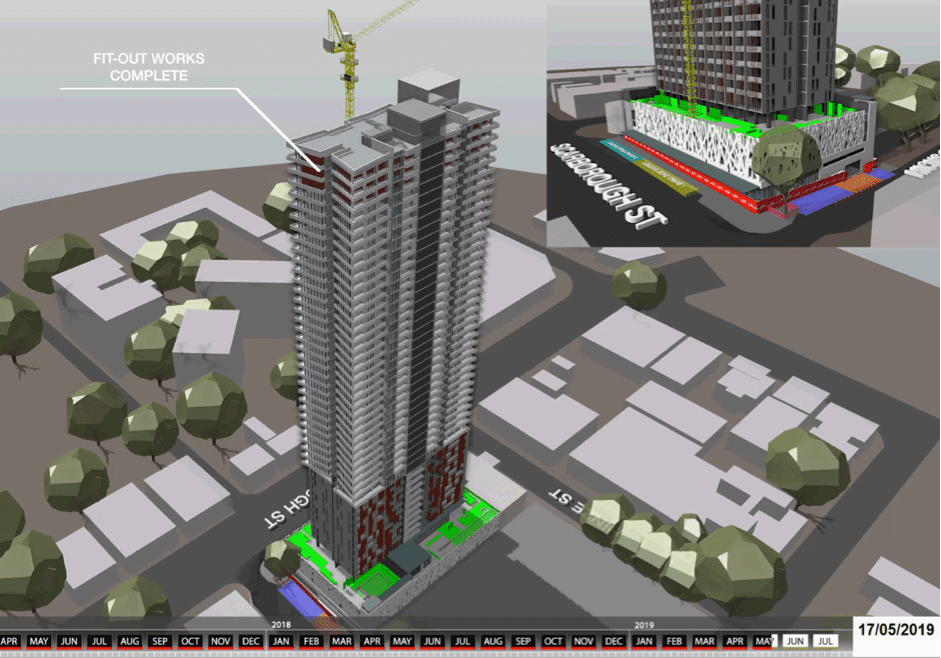
Over the past few months I’ve been working with our building team as it takes it’s 1st steps into the world of 4D scheduling. If you’re reading this, you probably agree with me that this is the way of the future.
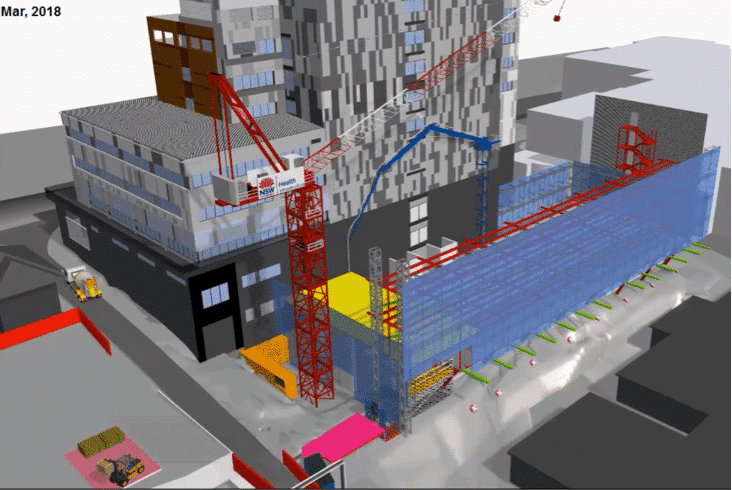
For those who aren’t familiar with the concept, 4D scheduling is the bringing together of a 3D model & a project schedule. In simplistic terms, activity bars on a Gantt chart are linked to corresponding elements of a 3D model (including plant & equipment) using additional software. The sequence can be played back to simulate the planned construction. In order to do this, you need a BIM model of some kind, software capable of reading it, and a project schedule.
Most people within the industry have now come across3D & 4D visualisations of one form or another, which are generally produced to jazz up a tender/ proposal submission. In essence these 3/4D visuals communicate complex methodologies in simple terms to varying stakeholders. I’ve been involved in this space for around 4 years now.
I whole-heartedly support producing this sort of communication with a submission, but I’d like to explain why I found 4D planning has significant value to add earlier in the chain – i.e. whilst working through the varying options & solutions for construction put forward by your team which will ultimately form the basis of your tender.
The value I see essentially boils down to 2 key points:
1) The ability to actually see what you’re doing and what you’re trying to build
This speaks for itself – the old cliché ” a picture is worth a thousand words”. The ability to look at the constituent parts of a building & test your potential solutions to its construction is of significant benefit & cannot be overstated. During my time involved in the 4D world, I can think of several examples where certain temporary work solutions have been put forward by very respectable professionals, only to be quickly jettisoned once viewed in context against a 3D model.
Better to find a problem with your solution during the planning phase than during the execution phase!
2) The ability to quickly and easily communicate your Gantt chart back to your team members.
Point 2 may need a little more unpacking – Others may disagree, but I believe that a planner’s greatest skill is the ability to communicate. This is twofold:
- First, to produce a meaningful schedule, we are required to speak to a lot of people, work out what’s going on inside their head & get it onto paper.
- Second, a Gantt chart (despite our best efforts) is hardly friendly on the eye & the reader needs a certain level of experience to be able to meaningfully interpret it. Therefore, it requires good communication on the planner’s behalf to explain what’s in it to whoever is reading it (in this instance the rest of your team).
To me, the ability to communicate the team’s intentions precisely is enhanced by having a visual tool. This can be changed many times, and each iteration or option can quickly be communicated back to your team & appropriate decisions can be made.
Ultimately this leads to enhanced certainty, which is a big issue for us in the construction industry – once the planning has been done in 4D, the consolidated, tested & verified plan can be submitted to the client & still add value to your submission.
As well as maintaining the push to utilise 4D scheduling in our pursuit of new business, my aim over the next year or so is to implement 4D planning through the delivery phase of a couple of projects we’ve recently been awarded – I’ll keep you posted as to our successes & failures.
Until then, I’d be very interested to receive comments & hear about other people’s experiences in this space.
About the Author, Chris Pilcher

Previously, he was the Regional Planning Manager for Solid Support in VIC. He was involved in Victoria rebuilding & running Solid Support’s operations & providing project planning expertise to builders & developers in the construction, development & civil engineering markets. He had full profit & loss accountability, including the generation of work.
Chris has a keen interest in 4d planning & the benefits this can bring to the planning process.
He has provided bid advice including scheduling & visualizations, due diligence reporting & project delivery phase schedule management for an array of projects in challenging environments, & is able to quickly analyze construction methodologies & find the most efficient route to project completion.
He can be reached at his LinkedIn profile.



![[Free 90-min Masterclass] How to Avoid Project Delays Turning into Costly Claims](https://www.projectcontrolacademy.com/wp-content/uploads/2025/08/September-2025-Webcast-Chris-Carson-H01-Yellow-2048x1152.jpg.webp)
![[Free 90-min Masterclass] The Ultimate Leadership Recipe for Project Professionals](https://www.projectcontrolacademy.com/wp-content/uploads/2024/08/4-2048x1152.jpg.webp)


